Twelve kind, curious, and adventure-seeking Americans and Canadians + four Tanzanian schools + three game parks + two nights camping in the bush = one truly amazing, once-in-a-lifetime safari.
AfricAid and Africa Adventure Consultant’s first guided trip to Tanzania concluded a few short weeks ago. Participants witnessed AfricAid’s programs first-hand and got to experience Tanzanian culture through school and home visits. And, of course, it included the classic safari experience. The group visited Tarangire, Ngorongoro Crater and Serengeti. In one day, they saw thirty lions and one leopard – and that’s just the cats.
The trip provided a very unique opportunity to see life-changing programs close-up and to enter Tanzanian schools and homes. The group visited two primary schools: Upendo and Losinoni, and two secondary schools: Muungano and Arusha Secondary. This was a blend of public and private, and urban and rural schools. Still, one thing was constant; there are thousands of bright, spirited, beautiful children who simply want to learn and make their lives and communities better. Children and travelers engaged in a postcard activity where each shared stories and pictures of their homes and lives at Losinoni, and sang, played, and asked questions to learn about one another at Upendo. Multiple home visits, including a visit to a traditional Maasai home, afforded the opportunity the better understand the culture in an authentic, unfiltered way.
The game park visits were extraordinary and offered the chance to see some of the famed wildebeest migration, as well as hundreds of other animals from the tiny dik dik to the mighty lion. Venturing out among a field of elephants is truly a life-changing, awe-inducing moment.
As we concluded this year’s trip, we’re already planning for next year. There’s certainly something in the air in Africa. The smell of smoke from cooking fires and fragrant flowers mix with sounds of calling birds and the occasional distant drum. Yes, there’s something magic in Tanzania and it’s not just in the air; it’s in the people. We hope each and every one of you can join us soon and experience it for yourself. Our 2012 safari will take place in June of next year and will be a family-friendly trip. For more information on AfricAid and Africa Adventure Consultant’s 2012 trip, please contact us.
Guest blog courtesy Elizabeth Abeshire (AfricAid). Photos courtesy Elizabeth Abeshire and Ashley Schulyer.
The next destination in my journey was Chobe National Park in Botswana. You can fly into either Kasane (Botswana), Livingstone (Zambia) or Victoria Falls (Zimbabwe) to get to Chobe. Flights to Livingstone and Victoria Falls tend to be more economical than to Kasane.
I flew into Livingstone and was greeted then transported to Chobe via the Kazangula border crossing. This is a river crossing; you are dropped by one guide and vehicle on one side and met by another guide and vehicle on the other. I love African border crossings (though I don't think that's a universal feeling amongst all travelers). They are most often very busy and some level of commerce is always present, as well as people, vehicles and animals. They are always interesting to pass through, and Kazangula just popped to the top of my list of favorites.
After being met on the Botswana side, we finished the border crossing and made the short transfer to Sanctuary's Chobe Chilwero Lodge. The lodge is perched on top of a bluff overlooking the Chobe river. It's very luxurious and intimate, with only 15 guest cottages. Each cottage is spacious with both indoor and outdoor showers, freestanding bathtub, luxurious bedding and a sitting area. Because of its location, it also has power for little luxuries like an in room mini-fridge (no wait for a cool beer on a hot afternoon!) and air-conditioning. In keeping with little luxuries, there is a private garden out back with seating and relaxing hammock, as well as seating out front overlooking the Chobe river.
There is a pool on the grounds for those hot days when you need a cool dip. The main area is airy, spacious and comfortable, with lots of indoor and outdoor seating; afternoon tea on the lawn is particularly lovely. There is wi-fi and cell phone reception if you must, or if you want to post a quick email home to let everyone know you arrived and that everything is wonderful, there's a guest computer available for use. The connection speeds are tolerable, but it's not broadband. There's a nice curio shop with all sorts of interesting things to take home to your family and a few supplies like batteries and such in case you forgot yours.
The food is exceptional - this was the case at all of Sanctuary's camps and lodges. Breakfast is a buffet followed by cooked options if you wish. Lunch is a buffet as well, with wonderful light choices, including a variety of healthy options. Dinner is plated and multi course. Additionally, you have a choice of entrees, and of course any dietary restrictions can be accommodated. When you travel, let us know in advance if there is anything you can't or don't wish to eat so we can make your wishes known early. At Chobe Chilwero, you have the option of dining inside or out, though barring terrible weather, I find dining outside in Africa to be wonderful and special any time of day.
Activities at the camp include game drives in Chobe National Park and sundowner cruises on the river. If you find either of these strenuous or just want to treat yourself, Chobe Chilwero has an amazing full service spa offering everything from couple's treatments for your romantic trip, body treatments, hydrotherapy and more. Book your treatment in the tree house for an extra special experience. I can attest to the credentials of the spa staff; I was lucky enough to have an absolutely amazing massage during my stay.
While you're waiting for the next report, don't forget to keep an eye on our Facebook page for trip photos, more trip report information and links to You Tube videos from our travels!
Next up: game drives and sundowner cruises in Chobe National Park - living the safari life!
As you know, several of us in the office recently spent time in Africa to see what's new, what's improved and what's happening. I had the pleasure of a quick but very interesting trip to South Africa, Botswana and Zambia.
I flew South African Airways from Washington, DC to Johannesburg. This flight stops in Dakar, Senegal en route. It's a quick and painless stop, but can be frustrating on a long journey to spend an hour somewhere you aren't staying. If you want to take a nonstop flight, the JFK (New York) to Johannesburg flight became nonstop on May 1st. I personally feel like it's better to get it all done in one fell swoop, but we'll leave that to seat availability and your discretion on your own journey!
Upon arrival in Johannesburg, I was met and greeted at the airport and escorted to the Gautrain station. Get it? Johannesburg is in Gauteng province, hence the Gautrain!
I hardly needed the escort, as the way to the train is very clearly signposted, but it's always nice to be greeted upon arrival. Joburg airport is amongst the best in the world; it has decent places to eat, great airport lounges for frequent fliers and shopping galore. I know a number of people that build a little extra time into their journeys just for the shopping!
Getting my Gautrain ticket was easy. There are automated kiosks as well as a manned booth. I opted for the latter and got a 'return' (two-way) ticket to Sandton, a desirable area of the city where my hotel was located. I entered the station with my 'Gold Card' (ticket) and awaited the train. The station was immaculately clean, well lit and staffed with security. The train runs frequently (every 12 minutes during peak hours), so you never have to wait long.
When the train arrived, I alighted and took a seat. The train was as spotless as the station and was comfortable. The ride to Sandton takes fewer than 15 minutes; a fraction of how long it might take by car depending on the traffic. The Sandton station is clean and well lit as well, and easy to navigate. I took the elevator and found myself on the street opposite my hotel; the RadissonBluGautrain.
The rooms at the Radisson are spacious and modern and will fulfill your needs for a short city stay. For dining, you will find the 'All Day Restaurant' in the hotel serving up very good food (including some traditional African dishes), with a nice wine list and views of the surrounding area. The breakfast buffet is staggering; it's a heck of a way to kick off your morning.
The hotel also has a bar, as well as a sundeck with a pool and an outdoor bar. If these aren't enough for you, there are a few restaurants within the building on street level, though I did not have the opportunity to dine at any of them as my stay was short. Finally, the hotel also has free wi-fi (and decidedly expensive computers for you to use if you don't have your own; about $7 for 15 minutes access) and good workout facilities.
I would submit that taking the train to the city after an 18+ hour journey is not for everyone; sometimes you just want to fall in the back of a vehicle and be whisked to where you're going. Definitely weigh this before deciding whether the Gautrain is right for you and your trip. The benefit is that it's a budget friendly way to get into Sandton. The drawbacks are that it requires some maneuvering after a very long and tiring journey, and only goes to two places (as of this writing), so the lodging options are very limited.
My return journey to OR Tambo the following morning was just as easy and uneventful. From there, I was off to Botswana and Zambia. More on that next week!
Mahale Mountains National Park in western Tanzania consistently ranks as one of the favorite places to visit in Africa amongst the staff here at Africa Adventure Consultants. It is without a doubt one of the most beautiful. This hidden gem is tucked away on the shores of Lake Tanganyika, its crystal clear waters reflecting the mountain range that starts just beyond the beach.
The park is best known for its chimpanzee trekking. It's a stone's throw from Gombe where Jane Goodall did her pioneering research, however it is 30 times larger than tiny Gombe. The chimpanzees are well habituated to human visitors, though with the size of the park you might sometimes have to do some serious hiking before finding them. At the tail end of my trip to East Africa in December, I was lucky to spend four nights at GreystokeMahale, which is now on my 'favorites' list, too. It's not an easy place to get to. After about 4 hours flying time from Arusha (depending on number of stops and routing), you'll reach Lake Tanganyika. From there, you'll board a dhow for the 90 minute boat ride to the camp, which on a calm day is a relaxing and visually stunning experience.
During my stay, there were only six total guests at Greystoke. We had varying fitness levels, which came into play when chimpanzee trekking. We were greeted at the airstrip by our guide Kakae, who accompanied us to camp. We had flown through some storm clouds en route, but the sun was out when we landed, and the waters were extremely calm. Lucky for me, as I don't have the strongest 'sea legs'. A multi-course lunch was served on the boat, complete with cold beverages.
Greystoke is set on a sandy beach and looks like a dream camp on a fantasy island. Thatched roof wooden bandas are exotic looking, but perfect for this remote paradise. With only six very private bandas, it feels like the most exclusive of retreats. The bandas as very well appointed with a four poster bed, a porch, a vanity and closet area, and a running water bathroom in the back. As an added bonus, there's a lounge upstairs (and the stairs are pretty unique!).
The bar area is tucked away in vegetation on a rocky outcropping; perfect for watching the spectacular sunsets over the lake. The food and service are the icing on the cake. More on that later! I would not recommend this property for anyone that might have trouble getting around, as it requires navigating sandy beaches and narrow stairs both day and night. Additionally, chimp trekking does require a moderate level of fitness, and can be strenuous, depending on where the chimps are located on the day you are trekking. As our boat came in to shore, we were greeted by a large number of the staff and made to feel instantly welcome. After we were oriented to the camp's workings, our first afternoon was all relaxation. We had a swim in the placid waters of Lake Tanganyika (the staff will tell you when and where it is safe to swim) and enjoyed thumbing through the primate books in the library overlooking the shores. Dinner was a communal affair and they accommodated my dietary requests, which meant I got fish...from the lake...yum!!
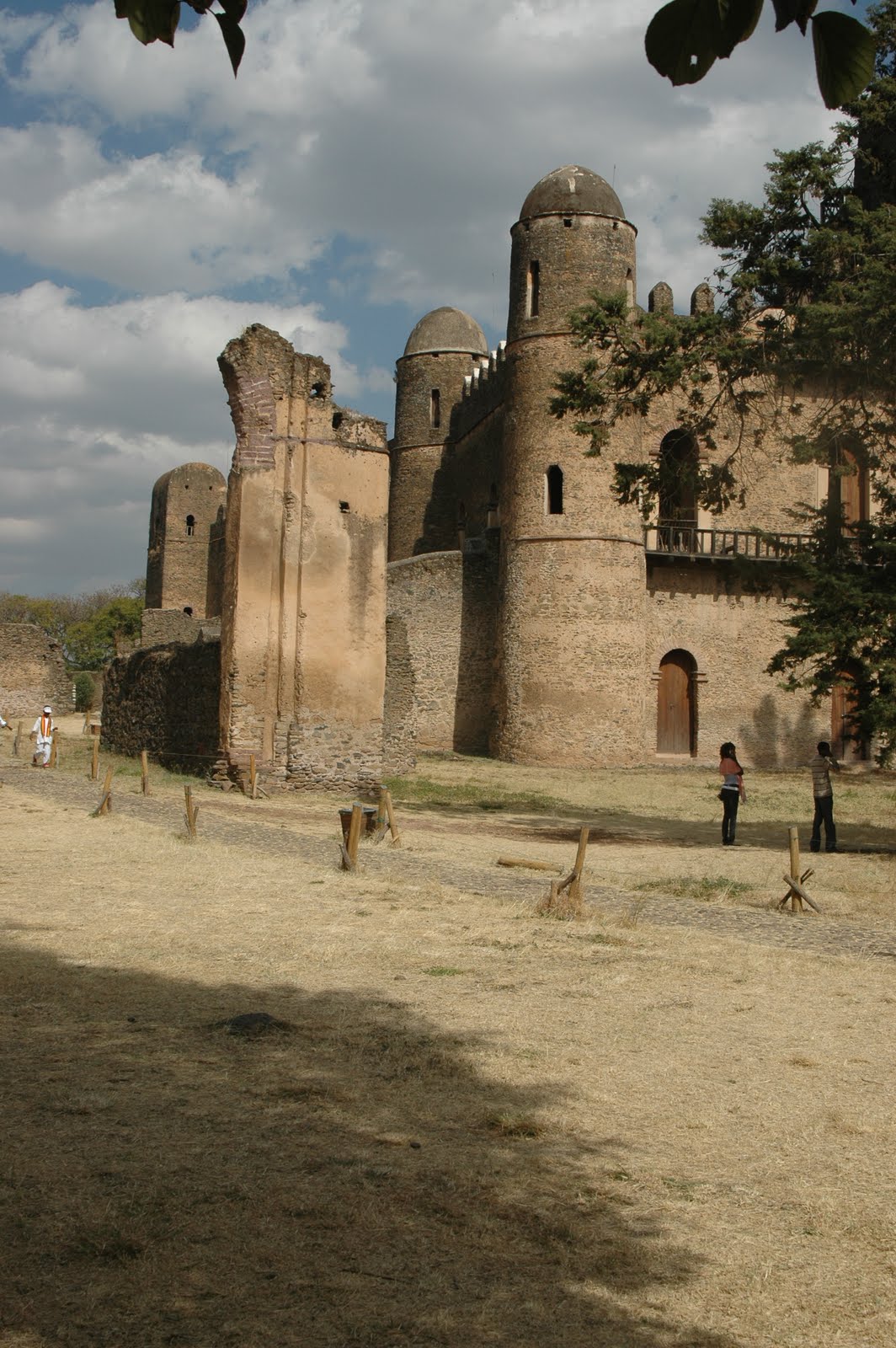
The drive from Bahir Dar to Gondar is a pleasant three hour excursion north along Lake Tana through farmland, mountains and plains. As with many Ethiopian towns, Gondar is very hilly, making it a hiker's delight and a challenge for those who are less mobile.
Since we arrived on the eve of the famous Timkat Festival, the streets were filled with Christian faithful from all over the region, here to celebrate Ethiopian Epiphany which commemorates the baptism of Christ according to the singular Ethiopian Orthodox Church. In Ethiopia, holidays are different (Christmas is January 8), as is the year (7 years behind the Western calendar) and even the time is told differently (6 pm our time equals noon Ethiopia time).
Gondar is worth a visit anytime to see 17th century castles and churches built by King Fasilidas and his progeny. It also makes for a great base from which to explore the beautiful Simien Mountains, home to endemic species such as Galada baboons, Walia Ibex and Simien red fox. We were here for Timkats, which exceeded my expectations in terms of pageantry, attendance and exuberance. Part religious service, part parade, and part party, it was a celebration in every sense of the word.
Really the festival spans several days. People attending the festival dress in sparkling whites and the priests in brilliant reds, greens, purples and golds. The festival begins with parades of arcs or "holy af holies," without which no Ethiopian church is consecrated. These are mini-replicas of the original Arc of the Covenant which, according to Ethiopian tradition, holds Moses's original 10 commandments and is said to have been brought my Menalik I from Jerusalem after he took it from King Solomon's temple. (Ethiopians believe Menelik I was the son of King Solomon's affair withe the Queen of Sheba who they believe was Ethiopian, though many scholars are not convinced). The arcs are brought from 40-plus regional churches to be blessed with holy water from King Fasilidas's pool.
The parade of arcs is led by bat wielding boys whose enthusiastic chants and jumps kept more than one onlooker far on the sidelines. Next come guards or escorts in red and and attendants in white. Sometimes floats are involved and there is lots of singing and chanting, drumming and horn blowing. Grass and heavy carpets are laid down before the procession of priests carrying the arcs, wrapped in cloth, on their heads, which are shaded by colorful umbrellas. This goes on for hours until all the arcs reach the walled pool. That night there was much singing, dancing and even fireworks in town while the priests spent the night praying by the pool.
The next morning, the faithful and curious trekked back to the pool for the service, some of which was translated into English for the foreign visitors in attendance. The pool is in an enclosed walled compound big enough for the clergy, some dignitaries, and paying tourists. The majority of people gather around the stone walls. The excitement was too much for some locals who created a mob scene as they pushed toward the walls, trapping the ones in front and causing the police to wield their batons with some force. Inside after much praying and chanting the water is blessed by Ethiopia's archbishop and all hells breaks loose as young men jump into the holy water and people use spray guns to hose the pilgrims. The clergy then parade the arcs back out and the people spend the rest of the day celebrating, some of them into the night.
In retrospect, Timkats was one of the most unique and impressive (and frightening) cultural events I've ever seen. It is certainly a sight to be seen for culture lovers, but people who don't like unruly crowds, noise and walking should stay away. There are also annoyances. I lost a bit of cash to pick pockets, which is not uncommon amongst such crowds. Hotel space is limited and reservations are not always honored, even when they have been paid in full.
The best hotel in town is the Taye, followed by the Goha, and the Qura and others like it. Next stop; Kelly accompanies the group to visit the Southern tribes.
From Lalibela, Bahir Dar is just 20 minutes by plane. A very pleasant town of 250,000 people, Bahir Dar sits at the south end of Lake Tana. Tana is Ethiopia's largest lake and the source of the Blue Nile, which meets the White Nile in Khartoum and then flows to Cairo, Alexandria and the Mediterranean Sea.
In Bahir Dar, we spent the morning visiting the Ura Kindnemihret monastery, one of many that are located on islands and peninsulas on Lake Tana. Getting there by boat makes for a pleasant excursion, especially if you get to see some reed canoes, white pelicans and more. The monasteries feature some vivid and colorful paintings illustrating scenes from the bible. After a tasty lunch we headed to the Blue Nile Falls. Much of the river's water is diverted to the hydroelectric damm so in the dry season the falls are not impressive. Even so, there were plenty of interesting sights to enjoy, making for a fun afternoon.
That night, we enjoyed authentic Ethiopian food in the stylish dining room of our hotel, Kariftu Spa and Resort. Set right on Lake Tana, the hotel is beautiful with huge rooms with wrap-around balconies. The hotel also has a large pool and wide deck with lake views. Guests also get one massage, pedicure or manicure (per room) at the hotel's spa.
Other hotel choices include Summerland, Abyiminch, Tana Hotel, Tana Resort, a Sheraton property.
Photo, left: Amhara man plays the misigo, a one stringed instrument made of goat skin and horse hair.
Lalibela is a must-see on any first visit to Ethiopia, and that's where we headed on the second day of our tour. About an hour's flight from Addis Ababa (if you book the direct flight and twice that with stops), it's a town of approximately 25,000 people who live perched on gorges, bluffs and steep hills in a mountainous and arid region northeast of the capital city.
The main reason to visit are the impressive rock-hewn churches, carved out of stone below ground level in the 12th century. For me, these churches (especially Bet Giyorgis) are spectacular, especially when one considers how and why they were built; the answers to which are clouded in legend as are so many things in Ethiopia. The churches are connected by a series of tunnels, bridges and bumpy paths, which can pose issues for those who are less mobile. The churches are hosted and guarded by priests who dutifully pose for pictures holding their impressive ceremonial crosses -replicas of which are available in a variety of materials and prices in the town's numerous curio shops. Other fun excursions include seeing a traditional coffee ceremony and navigating the bustling Saturday market. The market appeared to draw every single resident, young and old, from a 30-mile radius. My favorite expedition was a trek up Asheton Maryam, a stunning 3,600-meter peak above Lalibela. The trek can be done on foot, but using mules speeds up the trip and adds a lot of flavor, especially when novice riders are involved. Note - mule riders still have to walk up and down the steep parts! There are some very steep and slippery segments, so it's not for everyone.
Lalibela is a poor town in an isolated region, so infrastructure is basic but improving. The best hotels are the Mountain View and Tukul, followed by LAL, Jerusalem and the rather tired Roha. All are simple but clean with good service and decent food.
Next stop; Bahar Dar, Lake Tana and the Blue Nile.
This blissfully big park has abundant game which you can see in a vehicle or on foot. If you're intrepid you can also fly camp for an additional fee (weather dependent!). This involves sleeping away from camp on a bedroll with a mosquito net; nothing much between you and the stars. You'll have all the comforts of camp - the great cuisine, hot bucket showers, the works; but you'll get a deeper and more intimate bush experience. It's not for the faint of heart, but it's very memorable.
I did both traditional safari as well as a walking safari. Walking in Katavi is not on par with Zambia; I did not see nearly as many animals, but I enjoyed it just the same. My guide Phillip was incredibly knowledgable and made the walk very interesting. We saw elephants, antelope (there's lots of Topi in Katavi), giraffe and birds. I also got some tracking tips, and learned where not to stand when near a warthog den!
Because I visited in the green season (about three weeks into the rains), the game was more dispersed than in the dry season. Katavi is most famous for its abundant crocs and hippos. When its dry they can be seen in the thousands. Green season or no, I saw lots of hippos and crocs, as well as more giraffes than I have ever seen anywhere, antelopes, monkeys, buffaloes, and more birds than I can recall. I also saw a few unusual looking animals, such as a broken-necked giraffe and a hippo with his teeth growing more like warthog tusks (both pictured here). Unusual and interesting.
The magic of the green season (other than really attractive pricing) is that the animals are very relaxed. There is food and water for all. I saw monkeys using a young tree as a see-saw to play, hippos each with their own private pools (some on their backs while lolling in the mud), giraffe drinking all over the place (it's the riskiest spot for them to be in), and nobody looked hungry.
Elephants were in camp every day, and something was always nearby at night. My most memorable evening was spent by the fire after dinner. The chorus started with the hippos making their usual nighttime noise followed by a hyena 'whoo-ooo'-ing. The sing-song capped off with lions roaring as they came up the road. All in all, a pretty satisfying end to my day!
As I departed, the elephants came to see me off. Katavi is a camp I'm going to get back to as soon as I can; it's a really special place.
Don't forget you can see more video of our travels on our You Tube channel!
Next: Mahale Mountains National Park and chimpanzees!
My trip to Ethiopia started with a pleasant flight direct from Washington D.C.'s Dulles International Airport to Bole International Airport in AddisAbaba. With their new specially outfitted 777s, Ethiopian Airlines can now fly non-stop. That makes the trip just 12 hours, much faster than with any other airline. The planes are modern and comfortably outfitted, the service is good and the fares are reasonable. Ethiopian Airlines also has an extensive flight network within Africa, making it a reasonable choice for people traveling to other countries in East and Southern Africa.
Ethiopia has had its share of negative press over the years--famine, war, etc. which has led many people to imagine it to be a dry, barren wasteland. Nothing could be further from the truth, however. Much of the country sits on a high plateau which is incredibly fertile. Grains, vegetables, herbs and more are grown in abundance. Ethiopia is purported to be the birthplace of coffee and they make it thick and strong and unbelievably tasty. The people are extremely friendly and crime is relatively rare, even in Addis which has 3-5 million people.
Most visitors to Ethiopia spend one ore two nights in Addis. Undoubtedly the best hotel in town is the Sheraton. It is very luxurious, has incredible gardens and a huge, beautiful pool. Next up is the Hilton, which is frankly looking tired, but has a lively atmosphere. The Intercontinental is a great choice and I really like the Jupiter, which currently has Jazz nights on Thursdays (awesome) and Soul night on Saturdays in the bar.
With one day in Addis you can see most of the major sites. I enjoyed both the National and Ethnological museums, and a trip up Entoto Hill afforded great views of the city. The "palace" and church near the summit are mildly interesting. Back in town, the Mercato is purportedly Africa's largest open air market and is very lively and for me, a little claustrophobic. It employs somewhere near 13,000 people. As with any crowded city market, you're best to keep an eye on your wallet. The Holy Trinity Church is worth a visit if only to see the tomb of Haile Selassie.
Katavi National Park is remote - really remote. From Arusha, it takes about 4 hours, plus a refueling stop in Tabora, to get there. My plane was nearly private - just one other passenger who was on her way to Mahale Mountains National Park (my next stop after Katavi). She was from Italy and was nearly as excited as I was to be headed to some of the most remote areas in Tanzania.
After finally landing at the airstrip near park headquarters, I was met by my guide Phillip. The airstrip close to Chada Katavi is being resurfaced and should be done next season (around July 2011) if all goes to plan. This meant a long-ish game drive back to camp, but also allowed me to see more of the park than I might have otherwise.
Phillip had the vehicle kitted out with all the comforts including fly whisks for the tsetses and cold beverages. There is a bit of mopane woodland to traverse through, which is where the blasted tsetses can be found, but the fly whisks really are handy. It's also interesting scenery; not a lot of animals, but a few interesting things like technicolor lizards and bird life, as well as some human settlements which are very basic. The human activity included charcoal kilns and small trading centers, as well as agriculture.
We stopped for a bush picnic on the edge of the plain en route. It was incredibly peaceful watching giraffe and topi in the distance and gave me a chance to chat further with my guide. It turns out that for the duration of my stay, there were only a total of four guests in Tanzania's third largest park! We did manage to see the other guests once during a game drive, but that was it for seeing any other humans outside of camp!
We got back to camp in the afternoon with time for a cool drink, a shower and a short nap. I was warmly greeted by Mark and Kristen the camp managers. My tent was large and comfortable with a very big bed, a veranda overlooking the plain and a basic but very functional bathroom setup.
Katavi is rustic - no doubt about it, but it is a glimpse back to the glory days of safari. A guest will want for nothing here; the food and service are wonderful. You have power, a library full of interesting books, a campfire to while away the evenings, walking and driving safaris - it's a terrific package. But if you want an ultra luxury experience (or a shower that lasts more than a few minutes), this is not the camp for you. Bathrooms are, as I said, perfectly functional. They recently installed chemical toilets (to replace long drop toilets), and hot water is delivered in the mornings, as well as waiting for you after game drives and in the evenings at bedtime. Hot (bucket) showers are al fresco and are quite nice to get the day's dust off. If you wish, you can arrange for extra water for a slightly longer shower.
The camp is spread out and each tent feels very private. The maximum number of guests is 12 (six total tents), so you really get an intimate bush experience when you stay here.
There are some other guests that frequent the camp on a nearly daily basis - elephants. A large elephant family has found that they enjoy visiting the camp and its tamarind trees. It is a quiet oasis and they have made it part of their routine. The first time they visited during my stay, I was walking out from my tent and Phillip called out that I should stay put. I did as he said and then watched wide-eyed as the elephants materialized out of the woods and moved towards the library tent. They had no interest in me; I got to enjoy an uninterrupted and magical 10 minutes watching them move through camp.
Once they were past the library, I moved to the library and got another long view of the eles - this time from the comfort of a couch! As I said, this was a daily occurrence and often from different venues. It was one of the most special experiences I had in Katavi.
Next: Game activities in Katavi & nighttime lions!
After reluctantly leaving Clouds Lodge, I headed back to Kigali and an afternoon city tour. Kigali is a vibrant, clean and organized city. Taking a half day city tour allowed me to see and learn more about it.
By far, the most moving part of the city tour was my visit to the Genocide Memorial. Rwanda experienced a tragic genocide in 1994 and the Kigali Genocide Memorial is one of many memorials throughout the country that stand as a reminder of the genocide with the intent of preventing it from ever happening again. While touring the memorial is definitely a sobering experience, it provides a deep understanding of what happened in 1994, as well as giving insight into other genocides around the world. If you are in Rwanda, you will not know the country as well without this learning experience.
I once again stayed at the Kigali Serena for my final night in Rwanda. See my earlier trip blog for details on this excellent property. After a good meal and a great, but all-to-short sleep I was off to the airport for my very early flight to Arusha. As I was on a charter flight, we had a few stops along the way, including in Mwanza on Lake Victoria so that we could clear customs.
Arusha is a bustling city and the starting point for most safari activities in Tanzania. There are myriad lodging options from basic to luxurious and most travelers going on safari will spend at least one night here. This trip I stayed at Rivertrees Country Inn in Usa River, about 25 minutes outside of Arusha. If you are joining us on Africaid's Tanzania safari this May, you will have a chance to stay at this delightful property.
I stayed in a cottage on the river. All of the rooms are very nicely appointed, however the two cottages have added privacy and nice touches such as day beds, outdoor showers and pretty patios facing the river. The property rambles along the riverside and is a quiet respite from the city. There is a pool, a bar and restaurant as well as common areas with books, games, cozy gathering spots, and if you must - Internet access. The guest computer has a nice view of Kilimanjaro on a clear day. I'd recommend getting up early to see it before it clouds over!
The food was abundant and excellent, and the staff and owner were very welcoming. Most especially, I needed to recharge a bit after the excitement of the prior week. Rivertrees allowed me to do just that - a quiet spot with lots of nooks to relax in; both indoors and out.
While in town, I also visited the newly reopend Mt. Meru Hotel. It had only been open for two weeks when I visited, however with the polished service and the professionalism of the staff, you would never know it had just opened!
The hotel is elegant and luxurious. There are a variety of room types for the needs of every traveler, and all are very well appointed. Things like flat screen TV's are standard, and little luxuries like upgraded toiletries, robes and slippers are found throughout. The views are excellent; the front of the hotel faces Mt. Meru, while the back overlooks the amazing pool facilities and a beautiful golf course.
There are two restaurants as well as a coffee shop, and a sleek cigar and Cognac lounge. They claim to have the largest selection of wines, cognacs and spirits in East Africa. You'll have to visit to find out for yourself!
Mt. Meru hotel also has a world class spa with 'guaranteed relaxation'. If you need to wrap up a bit of business or check in on what's going on at home, they have state-of-the-art conferencing facilities. Internet speed and availability appears to be above average here.
I would recommend this hotel for travelers that want a bit of luxury before heading off to or coming back from the bush. It would work well for couples as well as families. If you're staying elsewhere in Arusha and just need a cool down, they also have pool access available for a fee.
After our community visit, my guide and I headed off across southwestern Uganda to the Nkuringo area of Bwindi. The drive is breathtaking. After getting back to the 'main' road, we took that road essentially to its end. The hills became steeper, and if possible they seemed greener. That may have been the storm clouds making the scenery looking dramatic!
We drove through the town of Kisoro, arriving just after what must have been a very substantial rain storm. The streets were running with water - knee deep in some places. People were picking their way through town trying to stay somewhat dry while balancing goods on their bicycles or their heads. It was a chaotic, colorful scene.
We had another hour and a half drive from Kisoro to our lodge. The area we drove through seemed less developed and more remote than anything we had experienced so far. There was less agricultural development due to the steepness of the landscape, and the hills were packed ever more tightly together.
We finally arrived at Clouds Lodge around dusk. This beautiful lodge is perched at the very top of one of Bwindi's hills, surrounded by forest. It is community owned, and employs its staff from that same community. The clouds were in fact present, swirling just below us on the mountainside. I was warmly welcomed by the staff and escorted into the lodge for a quick briefing. This had to go in the books as the best briefing ever, as it was accompanied by a complimentary hand and arm massage from the local spa staff.
The main lodge is airy and light. It has several fireplaces for cool nights and is full of couches that just beg to be curled up on with a book or a drink. The bar is at one end, while the elegant dining room is at the other. It has a veranda around 2 sides, with fantastic views of Bwindi and the Virungas beyond. Every day is a different view depending on how clear it is or where the clouds have landed, but every day is beautiful.
My room, or perhaps I should call it a villa, was just down the hill from the main lodge. It had a porch with another tremendous view and was surrounded by flowers and trees, with its own little garden in the front. Once inside, I found an enormous sitting room with those same welcoming couches and my own fireplace. The bedroom was as light and airy as the sitting room with an enormous bed, and access to the same pass through fireplace. The bathroom was large and luxurious with a shower.
Meals at clouds are fantastic. In the mornings, I enjoyed custom made smoothies with mint and ginger, muesli and a cooked breakfast (essential when trekking!). Lunches were hearty but not too heavy; things like salads and fishcakes. Dinners were sublime; three course affairs with expertly executed dishes with surprisingly creative sauces and desserts that I couldn't resist.
My second day of trekking could not have been more different from the first. The ranger station is only a few minutes walk from the lodge, and is much smaller than the Buhoma area. There is only one group to trek to see from here, with a total of two groups in the Nkuringo area. There is a small village and shop area outside the ranger station.
Nearly all of the trekkers wisely hired porters this time (see why that is important here). We began our trek from the ranger station. Trekking from Clouds to the gorillas is downhill, which is unique. It also means your return trek is uphill! The trail is very good for most of the way, and you don't reach the forest until you hit the valley floor and pass by the tracker's camp - about an hour into the hike. We once again lucked out with the weather and needed sunscreen rather than rain gear for our hike.
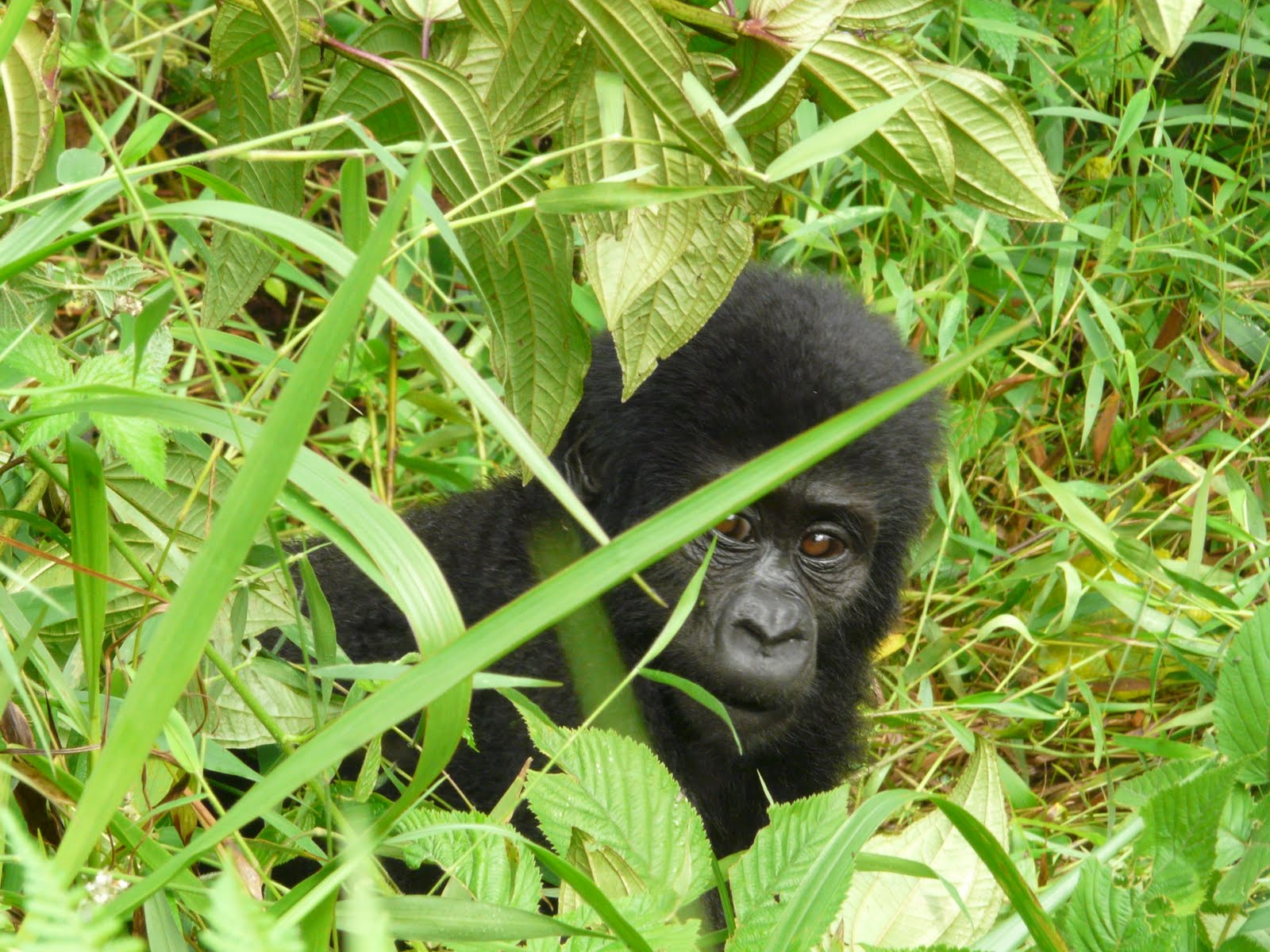
Once in the forest, it was only a matter of minutes before we were told to leave our gear with the porters and to take our cameras and follow the guides to the Nkuringo family group. We excitedly crept through the forest to the group and suddenly found ourselves nearly in the middle of it. They were feeding on the ground and in trees; there were babies, adolescents, black and silverbacks all within sight.
The gorillas were obviously comfortable with our presence and continued their feeding without interruption. One blackback came and sat directly in front of our group. He had a small wound on his left hip which he almost seemed to be showing us. Our guide confirmed that this family does in fact show the rangers and trackers any injuries they have in the manner we were witnessing. After he gave us a good, long look at his wound, the gorilla moved on to feed some more.
We enjoyed what felt like quite a long time of uninterrupted viewing of the gorillas as they moved around the clearing feeding, as well as the fun of two juvenile gorillas playing up in the trees. The group finally started to move off and as we still had time left in our hour we were able to follow them further into the forest for a bit more observation. At one stage, the silverback slapped the ground two times not far in front of me; I could feel it through my feet! This behaviour is considered to be one that prevents conflict between and among groups.
The final and most exciting part of the day for me was when one of the blackbacks (named Karibu - thank you in Swahili) sat nearly at my feet to feed. Because of the dense vegetation, I was unable to back away, so the guide advised me to stay put. The gorilla sat peacefully feeding for a few minutes before moving on his way, continuing to follow his family. Our time was finally up, and we left the Nkuringo family with regret, but also with joy at the privilege of spending time with one of the planet's most amazing creatures.
I mentioned before that it was difficult to put the experience of observing mountain gorillas in the wild into adequate words, and I feel I've had the same struggle in this blog. What I can say is that it is one of the most profound nature experiences that I have ever had, and is certainly amongst my favorite and most memorable experiences I have had in Africa. When we returned to the lodge, I enjoyed an afternoon massage which worked the fatigue out of my muscles and refreshed me immensely. The spa at clouds is simple, but the treatments are wonderful. I spent the rest of the afternoon in the lodge reading and talking with other guests. During our sundowner drinks, we were treated to a performance by a local youth community group. They sang and danced for the guests, incorporating the importance of gorillas to the community into their performance. (see performance video on our You Tube channel!)
We have several itineraries available that offer gorilla trekking in both Rwanda and Uganda. If you wish to stay at Clouds Lodge (and I can't recommend it highly enough!), we can create a customized itinerary for you. Just give us a call!
Next: Arusha and the newly opened Mt. Meru Hotel!
First photo courtesy Clouds Lodge. Remaining photos and video Gretchen Healey
Gorilla trekking in Bwindi - Habinyanja group - Gretchen's trip report #3
Trekking day, I had a 6:30am wake up call, which gave me enough time for a delicious cooked breakfast and to gear up for hiking. I took the packed lunch that Gorilla Forest Camp provided and loaded it into my backpack along with my rain jacket, camera gear and water. It was plenty heavy once loaded up, but I knew I would be hiring a porter before setting off.
I can't stress enough that anyone gorilla trekking should plan and budget to hire a porter. There are lots of reasons to do so, but the most important one is this: you are providing a local person with employment, which in turn incents them to continue to protect the gorillas and their habitat. Better yet, I can promise you that on a difficult hike, you will be grateful to not be carrying an awkward and heavy backpack and even more grateful that someone is there to help you on particularly difficult terrain. I am fit and I hike nearly every weekend year round at altitudes up to 14,000 feet, and I was plenty pleased to have hired a porter. It was $15 very well spent.
My permit for my stay in Buhoma was for the Habinyanja group, so after the informational session and briefing at park headquarters we headed off in our vehicle for an hour's drive to get to the trekking start point. Our hike began in an agricultural area but was a well utilized trail and was easy going initially. After the first hour or so, we broke off on to a smaller trail through cultivated fields, which was surprisingly steep and challenging with all of the dense crops and vegetation. We had a few stream crossings then eventually came upon a gorilla nest from the previous evening when we neared the edge of the forest.
Our UWA (Ugandan Wildlife Authority) ranger was in constant contact with the trackers, who reported that our habituated group of gorillas had just had an encounter with a wild group and the silverbacks had engaged in fighting. As a result, we had to do a fair bit of back tracking and enter the forest at a different place. In the meantime, the gloves had come out to hang on to vegetation while climbing steep hills, and the gaiters had done their job keeping safari ants and stinging nettles from annoying me.
We finally entered the Impenetrable Forest. We were immediately enveloped into the canopy, which was actually a cool relief from the blazing sunshine that had been upon us all day (lucky weather to be sure). The sounds were dampened and we could hear more birds and primate life around us, replacing the cheerful calls of local residents as we hiked by.
Another 25 minutes of up and down and we were in range of the gorillas. We put down our walking sticks and bags, grabbed only our cameras, then proceeded to a clearing where we spent an enchanting hour with the H group. They were resting under the forest canopy as a family; a few were feeding, but most were grooming and the young ones were playing.
It is hard to express the feeling I had while spending time in such close proximity to these magical apes. They come across as extremely gentle and you can see very clearly that they care for one another. One can also imagine the ferocity that might be possible in a rival silverback encounter, though I would stress that in my two days with the different gorilla groups, all that I witnessed was gentle, calm behaviour.
Each gorilla clearly has their own personality. The young were full of energy, and the youngest, a four-month-old infant, was so obviously treasured by his mother. The dominant silverback was watching over his family, as well as sitting down to groom and be groomed. Interestingly, the gorillas seemed to know when our hour was up; right at the appointed time, they rose from their family relaxation and slowly made off as a group. The hour seemed to go by in a flash, but I remember every moment of it like it only just happened.
The hike back was less arduous as we didn't have any of the backtracking, but the overall hiking time was near six hours. Getting back to the vehicle felt like a victory, and the shower and cold drink back at camp were immensly refreshing! I also took advantage of the opportunity to visit the Batwa (or Twa) community the next morning before my departure. A local guide took us on a walking tour of the nearby village. We were privileged to meet a number of people and get an intimate look at local industry. We saw a (banana) distillery and how banana juice, wine and gin are all produced, we walked through coffee and tea growing enterprises, and we also visited a local witch doctor who showed us a few of his secrets. These were just the highlights. It was nice to get an on the ground picture of the local community and to interact with some of the residents in this beautiful part of the world.
Next: Trekking to find the Nkuringo group from Clouds Lodge!
Video taken with a Flip video camera - it weighs nothing and slips into a pocket. Undoubtedly not the highest quailty, but fun for a novice videographer!
Rwanda was the second stop on my most recent African journey. A quick flight of just over an hour from Nairobi, Kigali is the vibrant capital city spread out over several hills and located in the center of the country. Its population is nearing a million residents, yet is one of the cleanest African capital cities I have visited, and has a very welcoming feel to it. Kigalis central location also means you can get to most other areas in Rwanda within a day with its notably good roads.
I stayed in the recently renovated Kigali Serena. They are putting the finishing touches on the renovation, however the bulk of the work is complete. The new rooms are smartly furnished with little luxuries like large, sunken baths, flat screen tv's and some are extra large with sitting areas and balconies. There is a great workout facility and a very nice outdoor pool. There are two dining options; a more formal buffet restaurant as well as a more casual open air restaurant next to the pool. The food was excellent at both. There was live entertainment poolside one evening during my visit, which provided a nice atmosphere.
From Kigali, I travelled overland to Buhoma in the Bwindi Impenetrable Forest in Uganda. The roads are good throughout Rwanda and the border crossing into Uganda is very easy. From the main road turnoff towards Buhoma the roads deteriorate, however. This journey isn't required to be done via vehicle; we can also arrange flights to an airstrip only an hour's drive from Buhoma. That said, the drive is very beautiful and interesting; there are people out and about everywhere (including on market day in the photo here) and on the more rural roads nearly everyone greeted the vehicle with a smile, a wave or a shout.
Along the roadside, you will see people and intensive subsistence agriculture. Crops such as banana, sorghum, millet and beans dominate the hillsides, and people are working in the fields or transporting goods along the roads. Driving will take you from these agricultural areas one moment and into the 25,000-year-old rainforest the next where you might see animals such as the black-and-white Colobus monkey or forest elephant. You'll pass through villages and see more common creatures such as cows, dogs and chickens. Eventually, you will reach Buhoma and the Bwindi park headquarters.
During my time in Buhoma, I stayed at Gorilla Forest Camp. This camp is situated within the park boundary and will get you to the headquarters with little fuss on the morning of your trekking. The camp has only 8 tents, each with lots of elbow room. The tents have comfortable beds, verandahs, and full en-suite bathrooms with both shower and huge soaking tubs which are kitted out with candleabra if you are inclined to have a hot bath after a hard day of trekking. The common area is close by and consists of a lively bar/lounge area as well as a dining area. The camp is known to sometimes have the occasional forest visitor, so you might get a lucky sighting staying here.
I double checked my bag for my trekking accessories; I brought long pants, a long sleeved shirt, a hat, gaiters and sturdy gloves for the trek, and I was glad for each of them, though I didn't discover all of the reasons for each of them until the next day.
Next installment: Gorilla trekking to find the 'H' group and a local community visit


 experience. The group visited Tarangire, Ngorongoro Crater and Serengeti. In one day, they saw thirty lions and one leopard – and that’s just the cats.
 make their lives and communities better. Children and travelers engaged in a postcard activity where each shared stories and pictures of their homes and lives at Losinoni, and sang, played, and asked questions to learn about one another at Upendo. Multiple home visits, including a visit to a traditional Maasai home, afforded the opportunity the better understand the culture in an authentic, unfiltered way.
 As we concluded this year’s trip, we’re already planning for next year. There’s certainly something in the air in Africa. The smell of smoke from cooking fires and fragrant flowers mix with sounds of calling birds and the occasional distant drum. Yes, there’s something magic in Tanzania and it’s not just in the air; it’s in the people. We hope each and every one of you can join us soon and experience it for yourself. Our 2012 safari will take place in June of next year and will be a family-friendly trip. For more information on AfricAid and Africa Adventure Consultant’s 2012 trip, please contact us.